Is AI really replacing these engineers?
Every glossy slide deck at the latest manufacturing summit promises the same thing: AI is about to automate your engineering, predict every failure, and make human error a thing of the past.
Really?
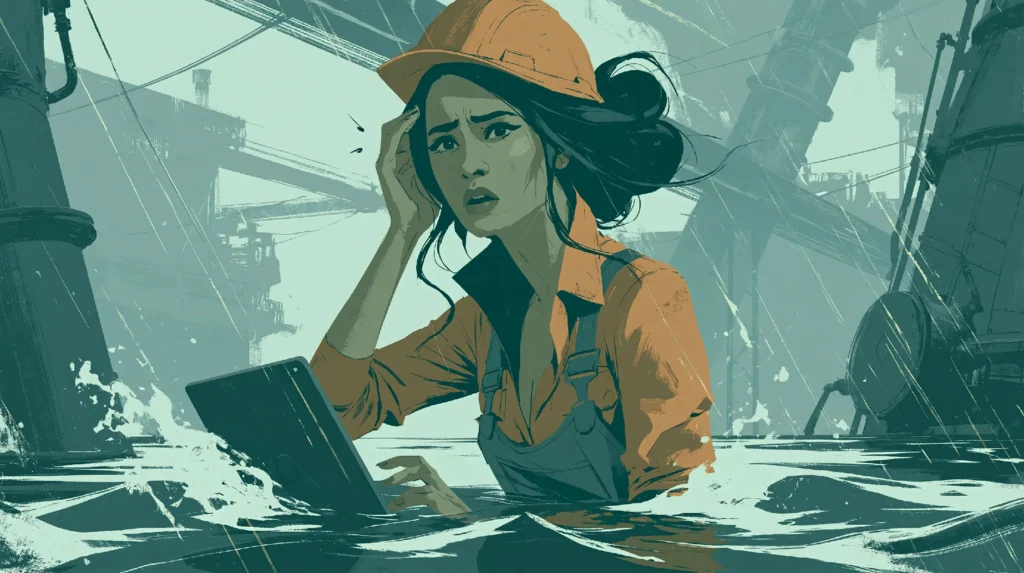
Reality Bites: Relying on AI, great in theory, but real life isn’t a theory
S**t, No Signal…
(…and It’s 3 AM on a Wet Tuesday)
Production line down. No internet. No documentation.
Tell me again how AI is replacing industrial engineers.
There is a massive amount of excitement around Artificial Intelligence right now. Every week brings a new model, a new tool, and a new claim that entire technical professions are about to disappear. Developers are supposedly obsolete, engineers are being reduced to “AI supervisors,” and complex projects will soon be delivered end-to-end by machines. Maybe…
…But before we buy into the hype, let’s go stand on a plant floor when a critical production line has ground to a halt. Not the air-conditioned conference room. Not the innovation centre. Not the glossy slide deck. The real environment. Where money is being lost every minute, customers are waiting, and everyone turns to one person and says: “Fix it.”
That is where theory meets reality. And reality doesn’t care about marketing.
Don’t misunderstand us—AI is remarkable. At inControl, we see its value every day. It can explain legacy protocols, generate foundational code, review hundreds of pages of documentation, write complex SQL, and suggest standard PLC logic blocks. It saves time, reduces repetition, and genuinely improves engineering productivity.
That value is real. But there’s a major condition that tech evangelists conveniently gloss over:
AI works best when everything is already in place.
It thrives when you have immaculate documentation, stable connectivity, pristine historical data, clear context, and a known problem. In other words, AI works best when a human being has already deeply understood the system.
Now, remove the safety net.
Line down. Unknown fault. The original system integrator went bust a decade ago. The documentation is wrong. The drawings are hopelessly out of date. There is no maintenance history, and you have conflicting opinions from three different operators on site.
Worse still: No signal. No Wi-Fi. No VPN. No AI. Now what?
The critical question changes overnight. It’s no longer “Can AI solve this?” It becomes: “Can your team solve this without AI?”
Handling that exact scenario has always been the true definition of industrial engineering.
Industrial automation engineering isn’t an exercise in information retrieval, it requires:
- Systemic Judgement: Weighing conflicting variables under immense pressure.
- Acute Observation: Looking at what is happening physically, not just digitally.
- Pattern Recognition & Hypothesis Testing: Constantly asking: What changed? What didn’t? What is the cause versus the symptom?
The best automation engineers can look “magical” when diagnosing a dark system. They aren’t. They’ve simply lived through thousands of failures and built an internal library of intuition from them. AI can describe those mental models in a report, but it doesn’t own them.
The biggest threat to modern manufacturing isn’t AI replacing engineers. It’s organisations stopping the development of them.
Think about it this way; A calculator doesn’t teach you mathematics. A GPS doesn’t teach you geography. An AI tool doesn’t automatically create an engineer.
AI creates productivity, not capability. And when complex industrial systems fail—and they inevitably will—capability is the only thing that matters.
Physical systems are unforgiving. Software bugs are inconvenient, but industrial failures are tangible. Valves stick. Motors overheat. Sensors drift. Power degrades. Connections corrode. Physical reality drifts away from digital models over time. When it breaks, production stops, expensive assets get damaged, and safety risks skyrocket.
That’s why experienced automation partners are inherently sceptical. We aren’t anti-innovation; we are just frequently humbled by reality.
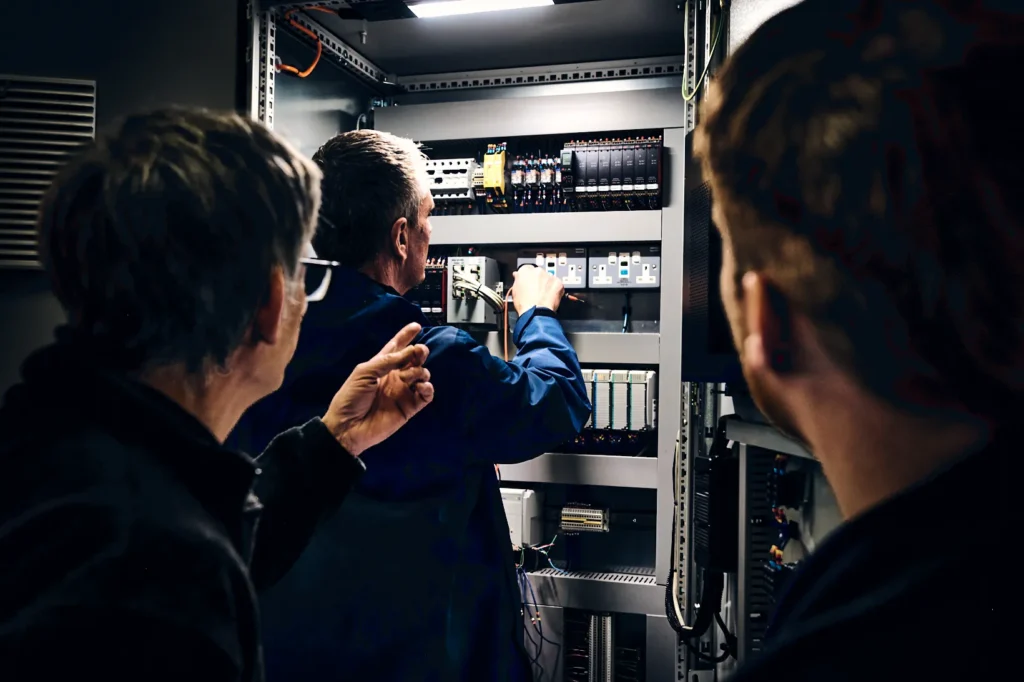
“That’s why experienced automation partners are inherently sceptical. We aren’t anti-innovation; we‘re just frequently humbled by reality“
The future of industrial automation isn’t AI replacing engineers; it’s AI amplifying them.
Imagine instant access to decades of legacy system knowledge, real-time log analysis, rapid comparisons of technical approaches, and automated drafting of standard documentation.
In this ecosystem, one truth remains absolute: The human still owns the understanding. AI is the assistant, the amplifier, and the accelerator. It is not the engineer.
Ask yourself, if your digital infrastructure disappeared tomorrow, could your current team still:
Diagnose a failed PLC network? Restart a stalled production line? Safely recover from a total power loss? Stabilise an erratic control loop? Fix a catastrophic fault they have never seen before?
If the answer is no, you haven’t built capability.
You’ve built dependency
Ultimately: Who Understands Your System?
AI will transform engineering—it already is, and at inControl, we embrace it to deliver faster, smarter results. But the most valuable asset in your risk management strategy will always be the engineer on-site. The one with no internet, hands on the system, who actually understands what is happening in the physical world.
Eventually, someone has to walk into the plant, listen to the machine, smell the overheating motor, challenge the assumptions, and fix the problem.
In that high-stakes moment, nobody asks who wrote the PowerPoint. They ask: “Who understands the system?”
I’m starting to recognise the patterns too…
I suspect the same is true for many other knowledge worker roles. But then, I’m not qualified to comment on that and likely many of you are not either, so you’ll have to ask Claude / Copilot / ChatGPT / Gemini or your other tech crutches yourselves.
Pat Nash
MD, inControl Systems
Are your industrial control systems protected against the unexpected?
At inControl Systems, we combine 25+ years of real-world engineering capability with modern automation tools to give you total peace of mind. Whether you need to modernise legacy setups or require a trusted partner to audit your system reliability, we are here to keep you moving.
Contact us today and talk to some real human beings about your systems integration needs and find out how we can help optimise your efficiency, productivity, and peace of mind.

From the Author
Every glossy slide deck at the latest manufacturing summit promises the same thing: AI is about to automate your engineering, predict every failure, and make human error a thing of the past. It sounds incredible in a climate-controlled boardroom.
But industrial automation doesn’t live on a server—it lives on a physical plant floor, where reality is messy, unpredictable, and entirely unforgiving. Before we hand the keys over to the algorithms, we need a reality check. Because when the sirens are blaring, the hype fades fast.